Ajinomoto Bio-Pharma Services
Packaging Associate II
November 2022 – December 2024
Ajinomoto Bio-Pharma is a CDMO (contract development and manufacturing organization) that produces and packages drug products for large brands. Its San Diego operations span three campuses: upstream fill-suites, visual inspection, and packaging/warehouse.
A few weeks into starting as a Visual Inspection Technician, I signed up for a walk-about with the Director of Drug Product Manufacturing and mentioned my background in circuits and robotics. This conversation led to me being relocated to the packaging department in order to consolidate the ownership of the site's automated equipment under one umbrella. I would later become the Subject Matter Expert of a Marchesini automated labeling and packaging line, an IMA automated cap-coding line, Optel Vision Systems, and Open Site Master (OSM, a site-level serialization management software).
Day to day
On a typical day running the automated packaging line, I would input the lot metadata into OSM, ensuring the downstream labelers and serialization equipment gets connected to the correct client Track-and-Trace servers and serial number caches. After loading the lot into the machines, I would provide on-the-floor support troubleshooting the equipment and preventing escalation to Engineering and IT for electromechanical or networking faults. Upon the completion of the lot, I would work with our QA team to close out the lot on OSM and transition the Track-and-Trace status.
Outside of packaging operations, I also led development work on both automated lines and traveled between campuses to troubleshoot and calibrate Optel Counting Stations. On the Marchesini Labeling and Packaging line, I worked to develop new recipes (physical and digital settings) to accommodate new vial sizes and packaging materials to expand our packaging capabilities. For the IMA Cap Coding line, I had the special opportunity to create new operating parameters from scratch in order to accommodate 2mL vials and complete the machine's qualifications.
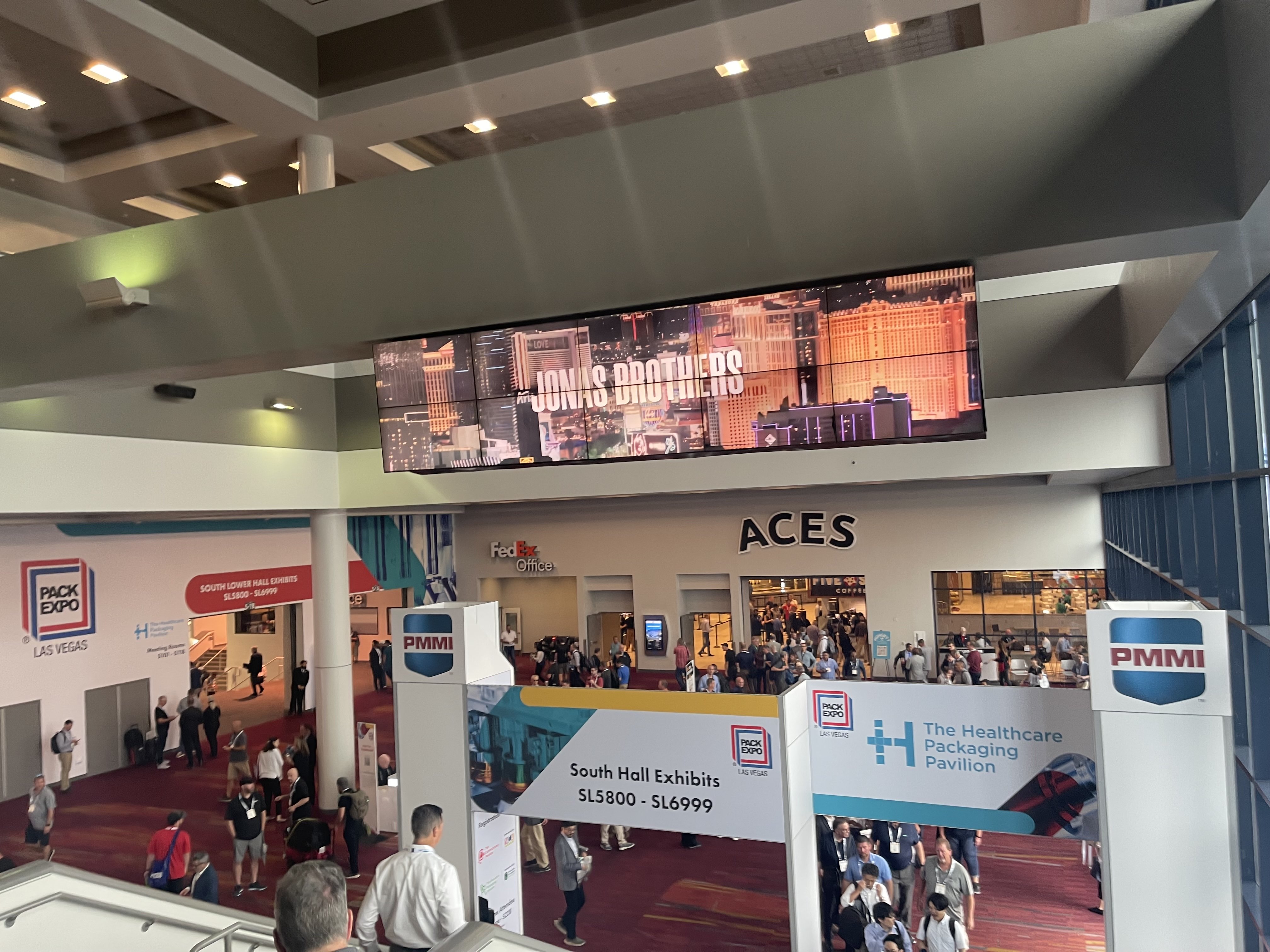
I have worked with cross-functional teams across Engineering, IT, QA, and with our vendors to implement system upgrades, execute protocols, and present revisions to technical documentation through the Change Review Board. I also had the opportunity of being sent to PackExpo, Las Vegas, with my boss to meet our Marchesini and Optel contacts in-person, and to view the cutting-edge of packaging technologies.
Occasionally, I would also be sent to assist in upstream operations. In the Fill Suite (ISO 7 Cleanroom), I helped offload drug products and shadowed the engineers as they troubleshot sterile/aseptic equipment and resolved in-process faults.
Qualifying the Cap-Coder
Moving into the packaging department, I was introduced to the IMA Vial Cap-Coder, an automated line that had gone unused for several years prior to my employment. I had the responsibility of getting the machine running at an optimal state and executing its Performance Qualification (PQ) after developing new recipes for it to run.
The Cap Coder prints codes directly onto vial caps using an ink jet and CO2 laser, inside a fully enclosed machine. Vials are held against a backplate by a wormscrew that advances them down the line. Without anything else constraining them, the round vials vibrate and rotate until the wormscrew releases it, entering the print enclosure at a random, unpredictable orientation. Due to this constraint, prior tests and development work depended on running vials through the printer to challenge the vision system, treating the materials as single-use and requiring the vials to be re-crimped for subsequent tests.
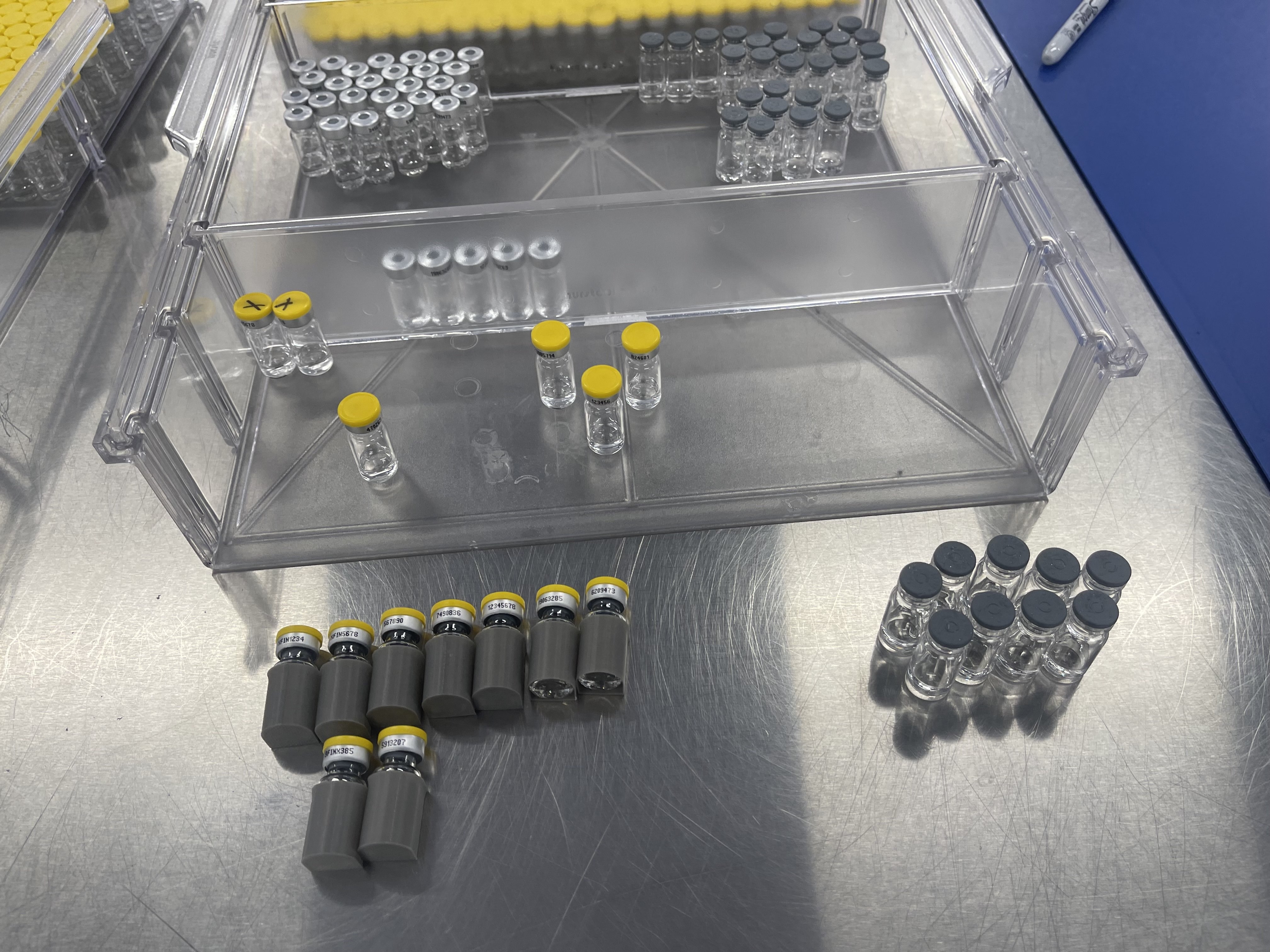
I designed and 3D-printed a sleeve that fits snugly around the vial with one flat edge. Pressed against the backplate, that flat edge can't roll, so the vial exits the wormscrew at the same orientation every time. Because we were no longer constrained by single-use vials, I was also able to develop a "library" of clean and intentionally defective prints in order to repeatedly challenge the onboard vision-verification system.
Top-down / conveyor line Vial re-use test fixture
With my new tools, I was able to optimize the Optel vision system's parameters from scratch, essentially eliminating all false-rejections and maintaining 100% rejection on our defect library and saving many man-hours from manually re-crimping the test vials. Without the sleeves, I also would not have been able to complete the PQ, as QA had required randomized sequential testing where a sequence of good and bad vials were run to intentionally challenge the vision-verification system.
Catching a serialization fault before it shipped
In my second year working in the packaging department, the labeling and packaging line's LineMaster system received an upgrade to Windows 10 from our vendor, porting a backup of our system and settings onto the new operating system. However, despite a successful execution of its Installation and Operational Qualification protocols (IQ/OQ), it was later found that the vendor had changed our production server settings during their internal testing to point towards their own test serialization servers.
Due to my ownership and administrator access of the automated equipment and OSM, I had become more restricted in participating in packaging operations to comply with separation-of-responsibilities. However, while I checked on my coworkers and the machines, I noticed that the serial numbers being printed were unusual for the particular client. The serial numbers printed were generated in a sequential pattern, but were much greater than seen in previous lots.
By auditing the OSM serialization database, I found that the production server had not been receiving the serial numbers from our client's Track-and-Trace systems, but rather pulling from an unknown test-server. I reviewed the audit trails on the systems to identify the misconfiguration as being present from the day the system had been upgraded and presented my findings to leadership. Without this gut-feeling, the lot would have continued downstream as the serial numbers were "valid" in the eyes of OSM, but lacked true traceability.
After presenting the issue in multiple high-level meetings, we were able to hold the vendor accountable, implement a correction to the server configuration, and repackage the client's lot.
Moving forward
By mid-2024, the packaging department was included in a site-wide layoff of more than 100 people. My team was kept on a retention contract through December, since a client still required our automated packaging equipment to finish out their production run.
Skills this drew on
Troubleshooting under pressure, reading audit trails and database logs to reconstruct a timeline, data integrity, executing IQ/OQ/PQ protocols, and the importance of Good Documentation Practices.